
 Steve Springer
Why NetSuite Implementations Fail (And How to Avoid It)
 Michael Rueda : Jun 29, 2026, 1:59:53 PM
NetSuite implementations fail for predictable reasons. Learn the most common causes and how to avoid them. See if your project is on track.
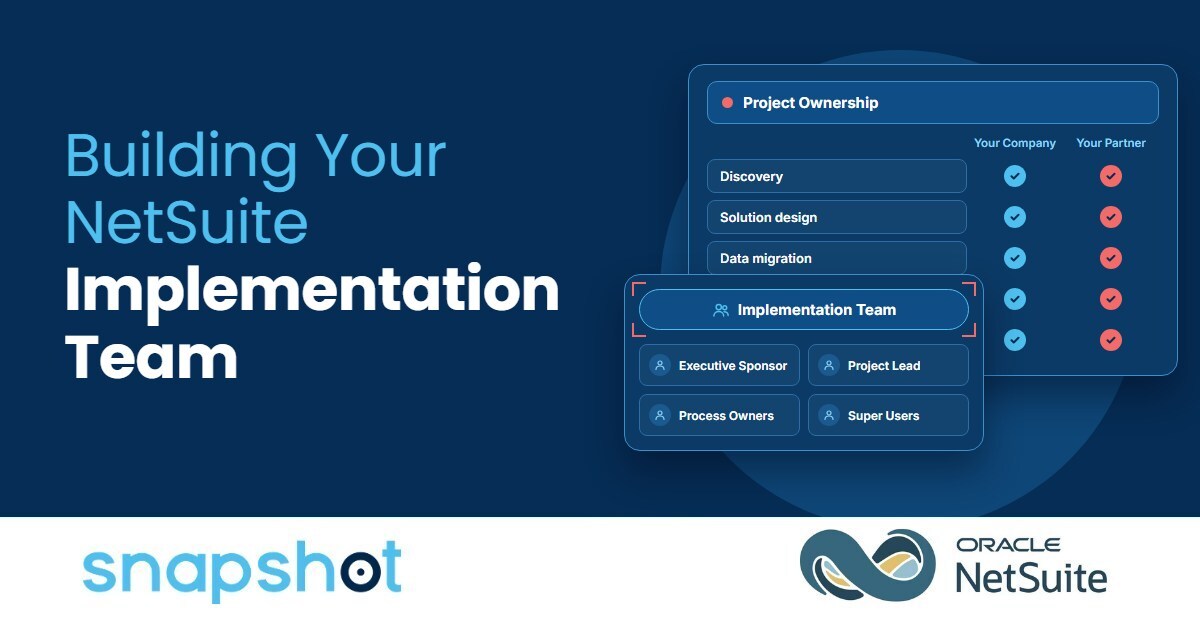
A NetSuite implementation team brings together people from your company and your implementation partner, each owning specific work from discovery through go-live and post-launch support. Your company supplies business decisions, process knowledge, data, and testing, and your partner supplies NetSuite expertise, configuration, and project methodology. Clearly defined roles on both sides help reduce the risk of decisions, data preparation, and testing stalling the project. Our NetSuite implementation services page covers what Snapshot's implementation work includes.
Snapshot has worked as a NetSuite Alliance Partner for more than 12 years helping manufacturers, distributors, consumer goods companies, and other operationally complex businesses implement and extend NetSuite.
A NetSuite implementation can include discovery, requirements definition, solution design, configuration, data migration, roles and permissions, reports and dashboards, workflows, integrations, testing, training, cutover, and post-launch support. Scope determines which pieces apply and how much work each task takes, so the team you build depends on what your project entails. A project that adds EDI connections or a NetSuite Warehouse Management System (WMS) rollout, which is an add-on module licensed separately, needs different people from a project focused on finance and order management. Our NetSuite migration checklist walks through each phase in detail.
An executive sponsor champions and drives the implementation strategy and typically makes final decisions about the project, which may include whether to increase the project budget and which business processes to automate. NetSuite describes the role as someone at or near the top of the organization who receives updates from the project manager.
Your internal project lead coordinates your company's side of the work: scheduling people for workshops and testing, tracking decisions and open items, and working with your partner's project manager. Your lead needs enough authority to get answers from department heads and enough time to do the job, so plan to move some of the lead's regular duties to others during the project.
Process owners from finance, operations and inventory, purchasing, and sales or order management explain how work gets done today and make design decisions for their areas. Decisions for manufacturers and distributors include how items and units of measure are set up, how pricing works for different customers, how locations are structured, and whether lot or serial tracking applies.
IT staff or a NetSuite administrator works with your partner on integrations and roles and permissions during the project and owns the system after go-live. A report writer works with your partner on the saved searches, reports, and dashboards each department needs.
Super users from each department raise concerns about the setup, test the system with real transactions, and help coworkers adopt NetSuite after go-live.
An implementation partner brings NetSuite expertise and a delivery methodology, with work that typically includes project management, solution design, configuration, development and integrations, data migration support, testing support, training, and cutover planning. A partner can lead the overall effort, but it generally will not cover every role on your side, because business decisions and process knowledge stay with your company. A partner can also provide ongoing support after go-live through managed services.
NetSuite implementation roles and responsibilities shift by phase. Your company and your partner share most phases, and ownership of decisions, data, and acceptance stays with your company throughout.
| Phase | Your Company | Your Partner |
|---|---|---|
|
Discovery
|
Explain current processes, goals, and pain points, and name process owners
|
Run process discovery and document requirements
|
|
Solution design
|
Make design decisions and approve the design
|
Propose the solution design and configuration approach
|
|
Configuration
|
Answer setup questions and review progress
|
Configure NetSuite, roles, workflows, reports, and dashboards
|
|
Data migration
|
Provide legacy data, confirm data ownership, validate converted records, and clean data in-house if you prefer
|
Map source data to NetSuite, clean and stage it, and complete planned migration cycles
|
|
Integrations
|
Confirm requirements with connected systems and their vendors
|
Plan and build integrations
|
|
Testing
|
Run user acceptance testing with real scenarios and sign off
|
Prepare test scenarios and support user acceptance testing
|
|
Training
|
Free up staff for training and prepare super users
|
Deliver training on configured processes
|
|
Cutover
|
Approve go-live and staff the cutover
|
Plan cutover and support go-live
|
|
Post-launch support
|
Own daily administration and report issues
|
Prioritize issues, transfer knowledge, and provide ongoing support as contracted
|
Responsibilities shift with the implementation model:
Choosing between NetSuite self-implementation and a partner depends on whether your team has NetSuite configuration experience and the time to take on project management, design, and integration work on top of their regular jobs.
A NetSuite implementation takes a significant share of some employees' time, and NetSuite notes that some of their other duties may need to be reassigned during the project. Your NetSuite implementation time commitment concentrates in four places:
Executive sponsor time clusters around decision points. NetSuite's implementation guide notes that a NetSuite implementation can take as little as three months or longer than six months, depending on the organization's size and the degree of customization, so plan backfill for the full project. Our post on why NetSuite implementations fail covers the planning decisions that put projects at risk.
Naming your executive sponsor, internal project lead, and process owners before discovery starts gives your partner the decision makers and data access the project depends on.
With more than 12 years as a NetSuite Alliance Partner, Snapshot helps manufacturers, distributors, consumer goods companies, and other operationally complex businesses plan and deliver NetSuite implementation projects, starting with discovery and data readiness. Our guide to preparing your data for a NetSuite migration covers the data side.
A NetSuite implementation team includes an executive sponsor, an internal project lead, process owners from finance, operations, purchasing, and sales, IT staff or a NetSuite administrator, and super users from each department. Your implementation partner adds a project manager, consultants for solution design and configuration, developers for integrations, and data migration support. Your company keeps ownership of business decisions, data, and user acceptance testing.
Your internal project lead coordinates your company's side of the project, scheduling staff, tracking decisions, and getting answers from department heads. Your partner's project manager runs the delivery plan, manages consultants and developers, and reports progress against scope and timeline. Both work together throughout the project, and your internal lead stays responsible for the decisions and resources only your company can provide.
Companies can implement NetSuite without a partner, either on their own or with implementation consulting from NetSuite Services. Self-implementation moves project management, solution design, configuration, data migration, and integration work onto your own staff, so it suits teams with NetSuite configuration experience and time beyond their regular jobs. Partner-led and hybrid models cover expertise your team does not have in-house.
A NetSuite implementation takes a significant share of time from process owners, data owners, testers, and your internal project lead, and NetSuite notes that some of their other duties may need to be reassigned during the project. Time concentrates in discovery and design workshops, data preparation, user acceptance testing, and training. NetSuite's implementation guide notes that an implementation can take as little as three months or longer than six months, depending on the organization's size and the degree of customization.
An executive sponsor champions and drives the NetSuite implementation strategy and typically makes final decisions about the project, which may include whether to increase the project budget and which business processes to automate. Sponsors receive updates from the project manager. NetSuite describes the role as someone at or near the top of the organization.
 Michael Rueda : Jun 29, 2026, 1:59:53 PM
NetSuite implementations fail for predictable reasons. Learn the most common causes and how to avoid them. See if your project is on track.
 Steve Springer : Aug 17, 2026, 9:15:00 AM
Use this NetSuite migration checklist to track progress across every phase of your implementation. See what needs to happen before you go live.
 Steve Springer : Aug 3, 2026, 12:45:00 PM
Poor data preparation is one of the leading causes of NetSuite migration failure. Here is what to audit, clean, and map before you go live.