
 Michael Rueda
NetSuite Sandbox Strategy for Administrators
 Sam Hettinger : Sep 14, 2026, 1:38:13 PM
A poorly managed sandbox creates production risk. Here is how to build a NetSuite sandbox strategy that keeps deployments clean. Talk to an expert.
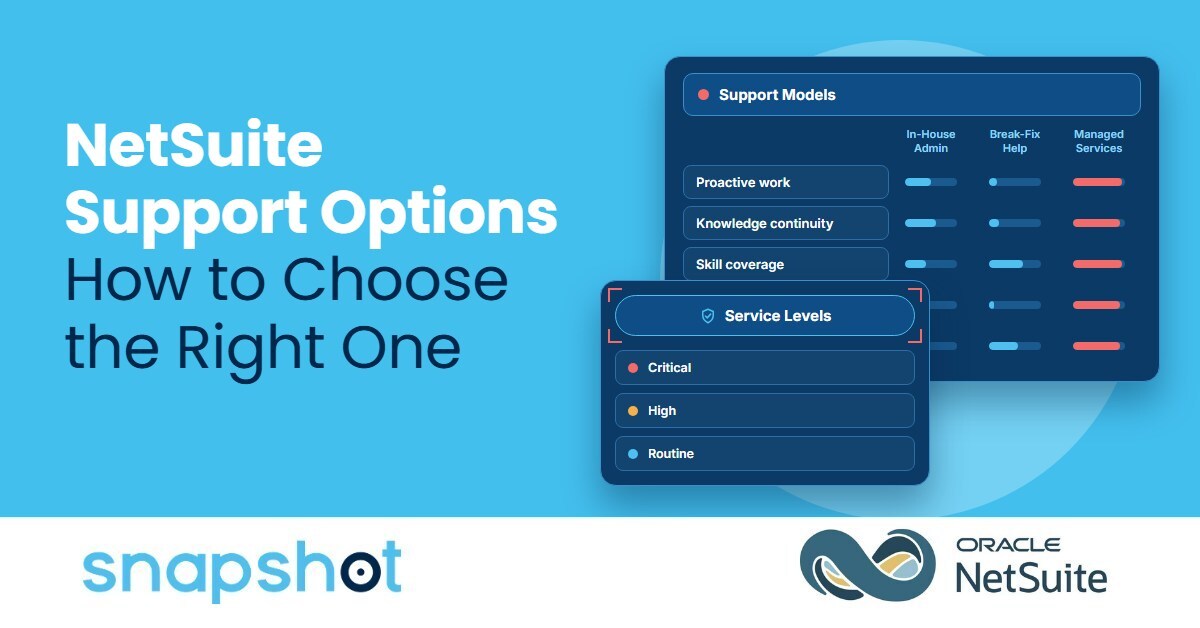
NetSuite support options include NetSuite's own support levels, an in-house administrator, break-fix help from a consultant, and ongoing managed services from a NetSuite partner. Choosing the right mix helps keep NetSuite releases tested, integrations running, and enhancement requests moving after go-live. Our NetSuite support and managed services page covers how Snapshot supports live NetSuite accounts.
Snapshot has worked as a NetSuite Alliance Partner for more than 12 years helping manufacturers, distributors, consumer goods companies, and other operationally complex businesses keep NetSuite stable and improving after go-live.
NetSuite offers two support levels, Basic and Premium, and a separate managed services subscription, Advanced Customer Support (ACS):
Partner managed services differ from Basic and Premium Support in scope: a partner works from your account's configuration, customizations, and integrations, handles requests such as new workflows, report changes, and integration adjustments, and monitors the account over time. A partner engagement works alongside your NetSuite support plan without replacing it.
Comparing NetSuite managed services vs. an in-house admin, along with break-fix help, starts with the work each model covers:
An in-house NetSuite administrator knows your business, processes, and people, and can respond to users right away. Coverage depends on one person's availability and skills, so vacations, turnover, and specialized work such as scripting or integrations can leave gaps.
Break-fix help brings in a consultant when something breaks and usually bills for the time spent. It covers occasional issues, but the consultant may need time to learn your account with each request, and break-fix arrangements usually do not include proactive work such as release testing.
Partner managed services provide ongoing, proactive coverage from a team that works from your account's configuration, customizations, and integrations. Work typically spans administration, release management, integration monitoring, user support, and enhancements, and the team builds familiarity with your account over time.
| Factor | In-House Admin | Break-Fix Help | Managed Services |
|---|---|---|---|
|
Proactive work
|
As time allows alongside daily requests
|
Usually not included
|
Release testing, monitoring, and planned enhancements
|
|
Responsiveness
|
Immediate when the admin is available
|
Depends on consultant availability
|
Defined by the service agreement
|
|
Knowledge continuity
|
Deep, but held by one person
|
Rebuilt with each engagement
|
Shared across a team
|
|
Skill coverage
|
Limited to the admin's skills
|
Matched to each issue
|
Functional, technical, and integration skills on one team
|
|
Cost structure
|
Salary and benefits
|
Often hourly, billed per issue
|
Often a monthly retainer or prepaid hours
|
|
Best fit
|
Steady daily requests and a stable NetSuite setup
|
Stable accounts with occasional issues
|
Growing companies with integrations, customizations, and ongoing change
|
NetSuite support providers may price their work in a few ways: hourly billing for break-fix requests, prepaid blocks of hours drawn down as work is completed, monthly retainers that cover a defined scope, and fixed-price projects for larger enhancements. Ask how unused hours in a prepaid block or retainer roll over or expire before you sign.
A service level agreement (SLA) defines how quickly a provider responds and how it prioritizes requests. An SLA typically sorts issues into priority tiers, from critical problems that stop orders or shipping to routine questions, and sets separate targets for response and resolution. Response time measures how fast someone acknowledges and starts on an issue, and resolution time measures how long the fix takes. Coverage hours matter as well, since a business-hours SLA does not cover a problem that appears at night or on a weekend.
Several signals suggest your current model no longer fits:
Our posts on NetSuite release readiness and NetSuite sandbox strategy cover how to test releases and changes before they reach production.
Ask any NetSuite support provider these questions before signing:
Your NetSuite support model should match how often your business changes, how much NetSuite expertise you have in-house, and how much risk you can accept when something breaks.
With more than 12 years as a NetSuite Alliance Partner, Snapshot provides NetSuite support and managed services for manufacturers, distributors, consumer goods companies, and other operationally complex businesses, and our NetSuite consulting and optimization work covers larger enhancements.
Your NetSuite support options include NetSuite's own support levels (Basic and Premium Support), NetSuite's separate Advanced Customer Support subscription, an in-house NetSuite administrator, break-fix help from a consultant, and ongoing managed services from a NetSuite partner. A NetSuite support plan can pair with any of the other options, and the right combination depends on how often your business changes and how much NetSuite expertise you have in-house.
NetSuite offers two support levels. Basic Support provides access to SuiteAnswers, NetSuite's self-service support site with support articles, help topics, and videos, and 24x7 phone support for critical issues. Premium Support adds faster response time goals, 24x7 coverage for severity 2 issues as well as critical ones, and coverage for lower-severity issues. NetSuite also offers Advanced Customer Support (ACS), a separate managed services subscription, sold in tiers, with hands-on product guidance, configuration, support, and ongoing optimization. The Optimize and Architect tiers require Premium Support.
NetSuite support comes from NetSuite and ranges from self-service resources and 24x7 critical issue support (Basic) to faster-response help across all severity levels (Premium), and NetSuite's ACS subscription adds hands-on guidance, configuration help, and optimization, with scope set by tier. Partner managed services come from a NetSuite partner that works from your account's configuration, customizations, and integrations, handling ongoing administration, release testing, integration monitoring, and enhancements. A partner engagement works alongside your NetSuite support plan.
A full-time NetSuite administrator fits companies with steady daily requests, a stable setup, and enough work to fill the role. Managed services fit companies that need a broader mix of functional, technical, and integration skills, or proactive release and integration work. Some companies combine both, with an in-house administrator handling daily requests and a partner covering specialized work.
Break-fix NetSuite support covers specific problems as they happen, such as a failed workflow, a broken script, an integration error, or a report that stopped working, often billed by the hour or per issue. It usually does not include proactive work such as release testing or monitoring, and the consultant may need time to learn your account before fixing each issue.
 Sam Hettinger : Sep 14, 2026, 1:38:13 PM
A poorly managed sandbox creates production risk. Here is how to build a NetSuite sandbox strategy that keeps deployments clean. Talk to an expert.
 Steve Springer : Nov 23, 2026, 1:32:43 PM
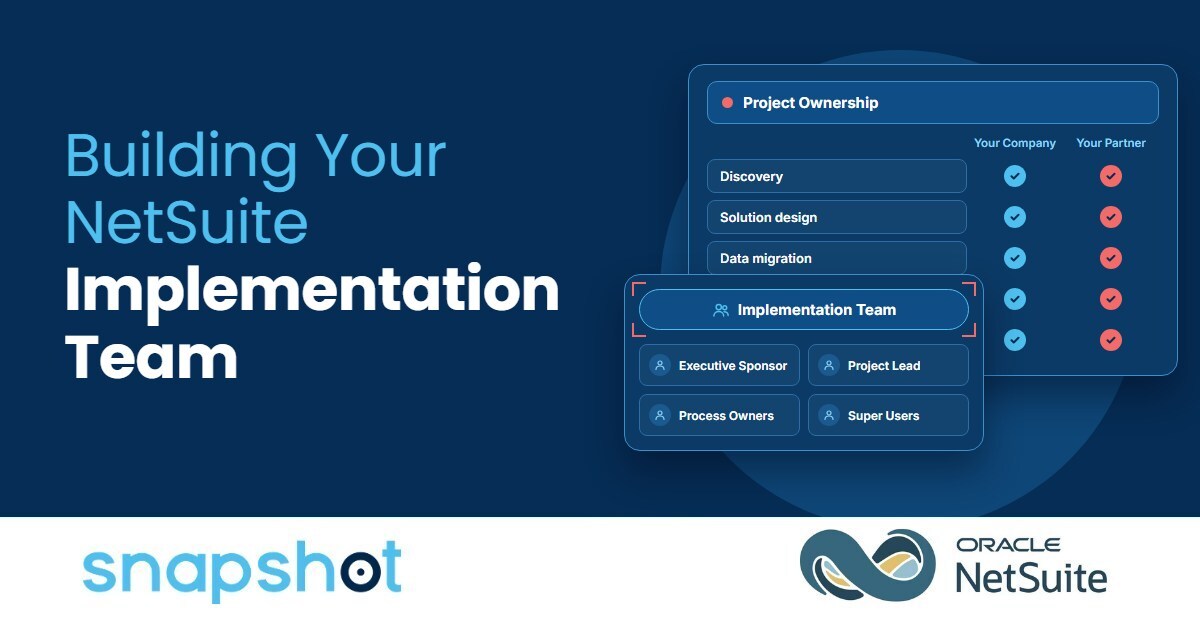
Plan your NetSuite implementation team: the roles you fill, what your partner delivers, and where your team's time goes. Learn more today.

 Michael Rueda : Aug 19, 2026, 9:45:00 AM
A guide to HVAC distribution ERP: what distributors need, where generic platforms fall short, and whether NetSuite is the right fit. Find out here.